
the parts of a home loan, in plain english
i used to think a home loan was just one big number you owed the bank. it isn't. it's a handful of separate parts, and once you can name each one, the whole thing stops being intimidating. here's the honest version, the way i finally understood it.
the first part is the principal: that's the amount you actually borrow. if you buy a $500,000 home with a $50,000 deposit, your principal is $450,000 (example only). the second part is the interest rate: the percentage the lender charges you each year for lending you that money. the third is the loan term: how long you take to pay it back, often something like 25 or 30 years. the longer the term, the smaller each repayment, but the more interest you pay over the whole life of the loan.
then there's the repayment type. most first home buyers use principal and interest, where every repayment chips away at both what you owe and the interest. the other option is interest only, where for a set period you only pay the interest and the loan balance doesn't shrink, which is more common for investors than for people buying a home to live in. finally, there are the features bolted on top: things like an offset account, a redraw facility, the ability to split the loan, or to make extra repayments. those features are where a loan goes from generic to actually suited to you, and they're what most of the rest of this page is about.
none of this is personal advice, by the way. it's general information to help you understand how the pieces fit. your own numbers, your own situation, and the right loan for you are all worth talking through with someone qualified.
example figures only, not personal advice. your own numbers and the right loan for you are worth talking through with someone qualified.
worth knowing
most first home buyers use principal and interest, where every repayment chips away at both what you owe and the interest. interest only, where the balance does not shrink for a set period, is more common for investors than for people buying a home to live in.how much can you borrow?
this is the question almost everyone asks first, and the honest answer is: it depends, and not on one thing. how much you can borrow comes down mainly to your income, your existing debts and regular expenses, your deposit, and the individual lender's own assessment rules. it is not a single fixed number, and two different lenders can land on very different figures for the exact same person on the exact same day.
i learned the hard way that scrolling property listings before i knew this number was just expensive daydreaming. it felt like research. it wasn't. working out roughly what you can borrow is the thing that turns 'one day' into an actual plan, because it tells you the price range you're really shopping in.
a few things move the number more than people expect. a credit card with a high limit can reduce your borrowing power even if you never use the full limit, because lenders assess what you could owe, not just what you do owe. ongoing commitments like car loans, buy-now-pay-later accounts and HECS or HELP debt all count. lenders also apply a 'serviceability buffer', testing whether you could still afford repayments if interest rates rose by a few percent, so the amount they'll lend is deliberately more conservative than what today's rate alone would suggest.
if you want the full walkthrough of the deposit side of this, my deposit and grants guide goes deep on how much you actually need up front. and a good mortgage broker can run your real numbers across multiple lenders at once, which is the only way to see how differently each one treats your situation. my dad, John Kefalianos, is a mortgage broker, so this is the part i grew up hearing about; if you'd like that done for you, you can book a chat with the team at Finance Lab.
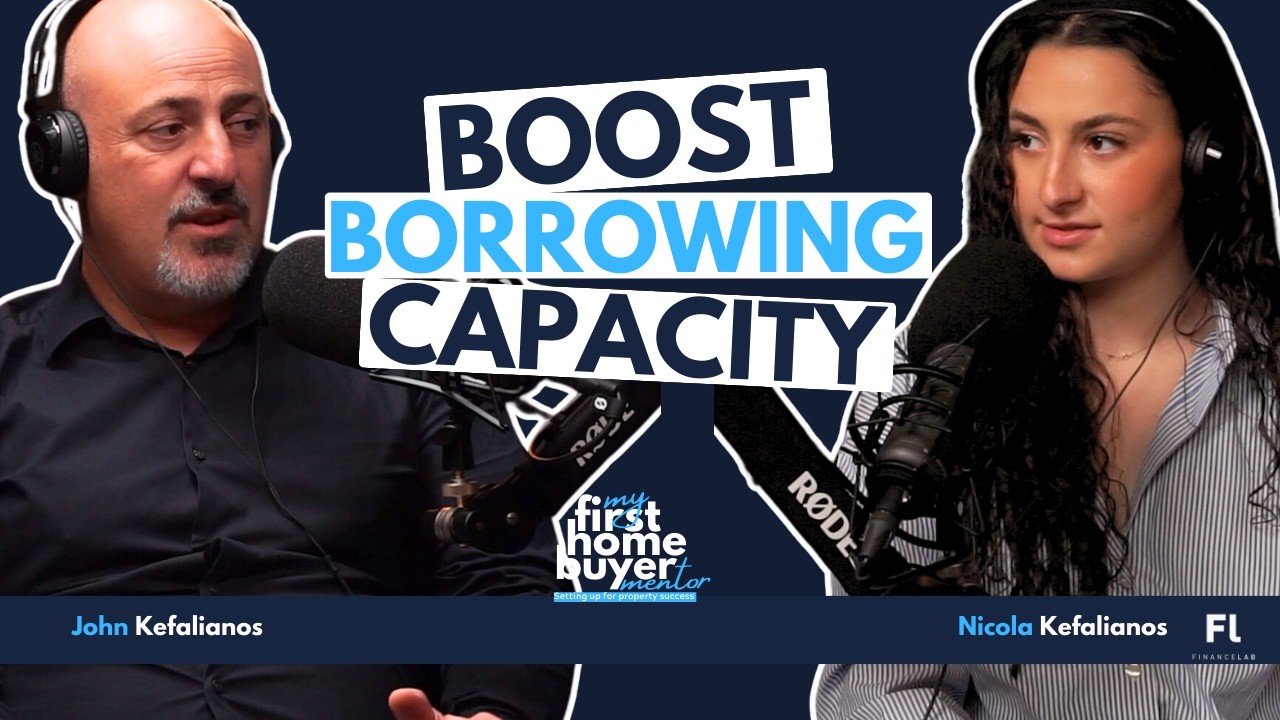
watch: what really sets the number, and why two lenders can land miles apart on the same person.
the bit i'd flag
scrolling listings before you know this number is just expensive daydreaming. work out roughly what you can borrow first, because it tells you the price range you are really shopping in.what is borrowing capacity and what changes it?
borrowing capacity is just a slightly more technical name for the same thing: the maximum a lender believes you can afford to borrow and repay without it tipping you over. it's the ceiling, not a target. just because a lender says you can borrow a certain amount doesn't mean you should borrow all of it, and i'd gently warn against treating the maximum as the goal.
the things that lift your borrowing capacity are pretty intuitive once you see them listed: higher and more stable income, a bigger deposit, and fewer existing debts. the things that quietly drag it down are the ones that catch people out. unused credit card limits, as i mentioned, get counted at the full limit. high day-to-day living expenses, which lenders increasingly check against your actual bank statements, reduce it. so does the serviceability buffer, which assumes rates higher than today's.
the practical takeaway i'd give my past self: in the months before you apply, your borrowing capacity is something you can actively improve. closing or lowering credit cards you don't need, clearing small debts, and showing clean, consistent spending all help. it's not glamorous, but it can be the difference between the home you want and the one you settle for. as always, this is general information, and your own capacity depends on your circumstances, so check it with a lender or broker who can see your full picture.
one to watch
borrowing capacity is the ceiling, not a target. just because a lender says you can borrow a certain amount does not mean you should borrow all of it.grab my borrowing power guide
the plain-english walkthrough of what lifts your borrowing capacity and what quietly drags it down in the months before you apply.
fixed vs variable: what is the difference?
this is one of the first real choices you'll face, and there's no universally 'right' answer, only the one that suits you. the difference is simple. a fixed rate locks your interest rate for a set period, often one to five years, so your repayments stay exactly the same for that whole time no matter what happens in the wider market. a variable rate moves up and down over time as the market and the lender's rates change, so your repayments can rise or fall.
the trade-off is really about certainty versus flexibility. fixed gives you certainty: you know your repayment to the dollar, which makes budgeting easy and protects you if rates rise. the cost of that certainty is less flexibility. fixed loans often limit how much extra you can repay, and many don't offer a full offset account, and if you break a fixed term early there can be a break cost that's sometimes significant.
variable gives you flexibility: you can usually make unlimited extra repayments, you often get features like a proper offset account and free redraw, and if rates fall your repayments fall too. the cost of that flexibility is uncertainty, because if rates rise your repayments rise with them. there's no rule that says you have to pick one and only one, which leads neatly into the next question. this is general information, not a recommendation; the right structure depends on your situation and your tolerance for repayment changes, so it's worth talking through with someone.
| feature | fixed rate | variable rate |
|---|---|---|
| what it does | locks your rate for a set period, often 1 to 5 years | moves up and down over time as the market and lender rates change |
| repayments | stay exactly the same for the fixed term | rise or fall with the rate |
| you get | certainty, easy budgeting, protection if rates rise | flexibility, usually unlimited extra repayments and features |
| the cost | less flexibility, often limited extra repayments, possible break costs | uncertainty, repayments rise if rates rise |
the honest part
fixed loans often limit how much extra you can repay and many do not offer a full offset account. break a fixed term early and there can be a break cost that is sometimes significant. this is general information, not a recommendation.what is a split loan?
a split loan is the 'why not both' option, and once i understood it, the fixed-versus-variable agonising got a lot less stressful. a split loan divides your borrowing into two portions: part of it fixed, part of it variable. you choose the split, so it might be half and half, or 70% fixed and 30% variable, or any mix the lender allows.
the appeal is that you get some of the benefit of each. the fixed portion gives you a chunk of certainty, so a stable, predictable part of your repayment that won't move if rates rise. the variable portion keeps some flexibility, so you can usually make extra repayments against it and often run an offset account on it. as an example only, if you borrowed $400,000 and split it 50/50, you'd have $200,000 locked at a fixed rate and $200,000 sitting on a variable rate with the flexible features.
it's not free of trade-offs. the fixed portion still carries the same limits on extra repayments and the same potential break costs, just on a smaller slice. and a split loan is one more thing to keep an eye on. but for a lot of first home buyers who genuinely can't decide, it's a sensible middle path that hedges the bet rather than gambling the whole loan on which way rates go. whether it suits you depends on your circumstances, so treat this as general information and check it against your own plan.
what is an offset account and how does it work?
this is the feature i wish someone had explained to me on day one, because it's quietly one of the most powerful tools attached to a home loan, and most first home buyers either don't know it exists or don't understand it.
an offset account is a regular transaction or savings account that's linked to your home loan. the trick is in the name: the balance sitting in that account is 'offset' against your loan balance before the lender works out the interest you owe. in plain english, the money in your offset account is treated as if you'd paid that much off your loan, for the purpose of calculating interest, even though it's still your money and you can spend it whenever you like.
here's how it plays out. say you have a $450,000 loan and $30,000 sitting in your linked offset account (example only). instead of charging interest on the full $450,000, the lender only charges interest on $420,000, because your $30,000 offsets it. interest on most home loans is calculated daily, so even money that's only in there for part of the month does some work. the beautiful part is that, unlike making an extra repayment, the $30,000 stays completely accessible. you can pull it out for an emergency, a holiday, or a new fridge, and the offset benefit simply adjusts the moment the balance changes.
that's why a lot of people run their everyday banking, even their salary, straight through their offset account: every dollar that sits there, even briefly, trims the interest. it won't be the right fit for everyone, some loans charge a higher rate or a fee for the feature, so it only pays off if your typical balance is enough to justify it. but for an organised saver, an offset account can save a meaningful amount of interest over the life of a loan. this is general information, not advice on which loan to pick, so run the numbers with a lender or broker for your own situation.
the bit i wish i'd known on day one
unlike making an extra repayment, money in your offset stays completely accessible. it trims the interest while it sits there, and you can pull it out for an emergency the moment you need it. it only pays off if your typical balance is enough to justify any higher rate or fee, so run the numbers for your own situation.redraw vs offset: which is which?
these two get muddled constantly, and they really do feel similar from the outside, because both let your spare cash reduce the interest you pay. but they work differently, and the difference matters more than people realise.
an offset account, as i just explained, is a separate account linked to your loan. the money in it is yours, sitting in your account, and it's subtracted from your loan balance for interest purposes. a redraw facility is different: it lets you make extra repayments straight onto your loan, and then redraw (borrow back) those extra payments later if you need them. with redraw, the money has actually gone onto the loan; you're pulling it back out when you want it.
the practical differences come down to access and treatment. money in an offset account is generally faster and easier to get at, often just a normal transaction or transfer, because it never left your control. redraw can sometimes be slower, may have minimum redraw amounts, and a lender can in some cases change or restrict redraw access. there can also be tax and structuring differences that matter a lot if you ever turn the home into an investment property later, which is exactly the kind of thing worth getting proper advice on before you choose.
the short version i'd give a friend: offset tends to suit people who want easy, everyday access to their savings while still cutting interest; redraw can suit people who want to throw extra at the loan to pay it down but like knowing they could get it back if life happens. plenty of loans offer both. which combination is right for you depends on your circumstances, so this is general information, not a recommendation.
| what it is | offset account | redraw facility |
|---|---|---|
| where the money sits | in a separate account linked to your loan, still yours | on the loan itself, as extra repayments you borrow back later |
| access | generally faster and easier, like a normal transfer | can be slower, may have minimum amounts, lender can restrict it |
| tends to suit | people who want easy everyday access while cutting interest | people who want to pay down the loan but keep a safety net |
worth getting advice on
there can be tax and structuring differences between the two that matter a lot if you ever turn the home into an investment property later. plenty of loans offer both, so which combination suits you depends on your circumstances.what is lmi (lenders mortgage insurance)?
lenders mortgage insurance, or LMI, is one of the costs that surprised me most, mainly because of who it protects. LMI is an insurance policy that protects the lender, not you, if you can't repay the loan and they end up out of pocket. you pay for it, but the cover is for them. it's worth knowing that clearly so it doesn't feel like a betrayal later.
here's when it usually comes up. lenders generally require LMI when you borrow more than 80% of the property's value, in other words when your deposit is less than 20%. the smaller your deposit, the bigger the LMI premium tends to be, because the lender is taking on more risk. it's commonly added to your loan rather than paid up front, which means you can end up paying interest on it too, so it quietly costs more than the sticker figure.
LMI isn't automatically a bad thing, though. for a lot of first home buyers, paying LMI is the trade that lets them buy years sooner instead of waiting to save a full 20% deposit while prices and rents keep moving. sometimes buying earlier and paying LMI works out better than waiting; sometimes it doesn't. it genuinely depends on your numbers. there are also government schemes that may let eligible first home buyers avoid LMI with a smaller deposit, and i cover those in detail in my deposit and grants guide, where every figure carries its government source. eligibility and amounts change, so check the current rules, and weigh it up with someone who can see your full picture.
rough guide only, check the current rules. LMI is commonly added to your loan, so you can end up paying interest on it too.
pre-approval: what it is and when to get it
pre-approval, sometimes called conditional approval or approval in principle, is a lender's indication of how much they'd likely be willing to lend you, based on a preliminary look at your finances. the word i'd underline is indication. it is not a final yes, it usually comes with conditions, and it typically has an expiry date, often around three months.
so why bother? because it changes how you shop, in two real ways. first, it gives you a confident price range, so you stop wasting weekends on homes you can't actually finance and start looking at the ones you can. second, when you do find the right place, pre-approval makes you a more serious buyer in the eyes of agents and sellers, because they can see your finance is largely sorted rather than hopeful.
the order matters, and this is the bit i got wrong in my head at first. get the money clear first, then go looking. the natural instinct is to find the dream home and then scramble for finance, but doing it backwards is how people fall in love with something they can't fund. a couple of honest caveats: a pre-approval isn't a guarantee, because the lender still has to value the specific property and re-check your circumstances before unconditional approval, and applying for several at once can affect your credit file. for most buyers, getting finance pre-approval before making serious offers is the stronger position. this is general information, so talk to a lender or broker about the right timing for you.
how interest rate changes affect your repayments
this is the one that keeps first home buyers up at night, and fair enough, because it's real money. on a variable loan, when the lender changes its interest rate, your repayments change too. rates go up, your repayments go up; rates come down, they come down. on a fixed loan, your repayments stay the same for the fixed term regardless of what the market does, which is the whole point of fixing.
to make it concrete, even a small-sounding rate move matters on a big balance. as an example only, on a $450,000 loan, a 0.5% rate rise adds roughly $2,250 of interest a year before compounding, which is around $187 a month more to find. i'm not pinning that to today's rates, because rates move, but the shape of it is the lesson: on a large loan, fractions of a percent turn into real monthly dollars.
this is exactly why lenders build in that serviceability buffer i mentioned, testing whether you could still cope if rates rose by a few percent. it's also why the loan features matter so much. an offset account, extra repayments and a sensible buffer of your own all soften the blow of a rate rise, because you've already been paying ahead or trimming the interest. the calmest first home buyers i've spoken to aren't the ones who guessed rates right; they're the ones who built a bit of room into their budget so a rate change is an inconvenience, not a crisis. how rate changes hit your specific loan depends on your balance, structure and rate type, so treat this as general information and check your own numbers.
the honest part
the calmest buyers i've spoken to aren't the ones who guessed rates right, they're the ones who built a bit of room into their budget so a rate change is an inconvenience, not a crisis. an offset, extra repayments and a sensible buffer of your own all soften the blow. hear it on the showhow much can i borrow? what every first home buyer should know
 hear it on the showdo this to maximise your borrowing power!
 hear it on the showthe one trick that could halve your mortgage term
 hear it on the showhow interest rates impact your mortgage in australia
 hear it on the showthe impact of interest rate drops to your borrowing capacity
 hear it on the showhow renting a room can boost your home loan capacity
 hear it on the showlimited borrowing capacity? guarantor loans explained
related guides
the first home buyer guide what it costs to buy a first home deposit, grants and schemes the buying process building and new homes settlement and legals every question, answered free guides and checklists
common questions
what is an offset account?
an offset account is a transaction or savings account linked to your home loan. the balance sitting in it is subtracted from your loan balance before the lender works out the interest you owe, so your own savings reduce your interest while staying fully accessible to you. this is general information only, and not every loan offers one, so check the current rules and what your loan actually includes.
how does an offset account work?
the money in your linked offset account is treated as if you'd paid that much off your loan, but only for calculating interest. as an example only, on a $450,000 loan with $30,000 in offset, you're charged interest on $420,000, not the full amount, and because interest is usually worked out daily, even short-term balances help. you can still spend the money any time, and the benefit adjusts as the balance moves. fees and rates vary by loan, so this is general information and worth checking for your own situation.
what is the difference between redraw and offset?
with an offset account, your spare cash sits in a separate linked account and is offset against your loan for interest purposes, while staying easy to access. with redraw, you make extra repayments straight onto the loan and can pull those extra amounts back later if you need them. offset is usually faster to access and treated differently for tax if you later rent the place out. which suits you depends on your circumstances, so treat this as general information and get advice before choosing.
should i choose a fixed or variable home loan?
there's no universal answer. fixed locks your rate and repayments for a set term, which gives certainty but usually less flexibility and possible break costs if you exit early. variable can move up or down, which gives flexibility and features like a full offset, but less certainty. some people split the loan and take some of each. the right choice depends on your budget and how much repayment change you can handle, so this is general information, not a recommendation, and worth talking through with someone.
what is a split loan?
a split loan divides your borrowing into two portions, part fixed and part variable, in whatever mix the lender allows. the fixed part gives you a stable, predictable chunk of repayment, while the variable part keeps flexibility like extra repayments and often an offset account. it's a way to hedge rather than bet the whole loan on which way rates move. the trade-offs of each portion still apply, so check the current rules and whether it suits your situation.
what is lmi and when do you pay it?
lenders mortgage insurance, or LMI, is an insurance policy that protects the lender, not you, if you can't repay and they're left out of pocket, even though you pay for it. lenders generally require it when you borrow more than 80% of the property value, meaning a deposit under 20%, and the smaller your deposit the larger the premium tends to be. some government schemes may let eligible first home buyers avoid it with a smaller deposit. eligibility and amounts change, so check the current rules and weigh it up for your own numbers.
what is home loan pre-approval?
pre-approval is a lender's indication of how much they'd likely lend you, based on a preliminary look at your finances. it's not a final yes, it usually comes with conditions, and it typically expires after a few months. it helps by giving you a clear price range and making you a more serious buyer when you find the right place. the lender still has to value the property and re-check your details before unconditional approval, so this is general information and worth confirming the timing with a lender or broker.
what is borrowing capacity?
borrowing capacity is the maximum a lender believes you can afford to borrow and repay. it depends mainly on your income, your deposit, your existing debts and expenses, and the lender's own rules, including a buffer that tests whether you could cope if rates rose. it's a ceiling, not a target, and two lenders can land on different figures for the same person. you can often improve it before you apply by clearing small debts and reducing credit card limits. this is general information, so check your own capacity with a lender or broker.
general information only, not personal financial advice. Finance Lab, Credit Representative Number 425945, authorised under Australian Credit Licence Number 389328. scheme, grant and cost figures are explanatory only, change regularly, and were last reviewed june 2026. always confirm current rules with the relevant government source.