
which melbourne suburbs are affordable for first home buyers right now?
let me be straight with you, because i remember how this felt. melbourne is a big, spread-out city, and the word "affordable" means something completely different depending on which ring you're looking at. the inner suburbs, the ones everyone pictures, are mostly out of reach on a first home buyer budget. that's just true, and pretending otherwise doesn't help anyone. but melbourne is also one of the few big australian cities where you genuinely can still find a first home under $600k, you just have to know where to look.
right now, the affordable end of melbourne sits in two places. the first is the outer growth corridors, the newer estates on the city's edges where house and land and brand-new townhouses are still being built and priced for first home buyers. the second is a scatter of established middle-ring suburbs where the houses themselves cost more, but units, apartments and small townhouses come up at prices a first home buyer can actually reach. so the real question isn't "is melbourne affordable," it's "which type of home, in which corridor, fits my deposit and my commute."
i'm not going to name a suburb and tell you it costs a specific number, because property prices move month to month and i'd hate for you to plan around a figure that's already out of date. what i'll do instead is walk you through the corridors and the kinds of homes in each, so you know where to point your search. then always, always check current listings on a couple of the big property sites before you get attached to a postcode. that's the single most useful thing you can do this week.

watch: the honest version of where you can actually buy in melbourne.
what counts as affordable in melbourne in 2026?
"affordable" is one of those words that sounds simple and isn't. for a first home buyer, affordable doesn't mean the cheapest place on the market. it means a home you can buy with the deposit you've actually saved, repay without your whole life going on hold, and live in without a two-hour commute eating your evenings. so before you fixate on a price tag, work backwards from what you can genuinely service.
as a rough working frame, a lot of first home buyers searching melbourne are looking somewhere under about $600k, because that's where units, townhouses and outer-corridor homes start to line up with first home buyer deposits and the victorian price caps for the schemes. but "under $600k" is a search filter, not a budget. your real budget is whatever a lender will lend you plus your deposit, minus the upfront costs nobody warns you about, things like conveyancing, inspections and any stamp duty you do end up paying. i've got a whole rundown of those on the cost of buying a first home page, and they genuinely change the number.
here's the honest version of how i'd think about it. set your true budget first, with your own numbers, then let that decide which melbourne corridors are in play, not the other way around. it's tempting to find a suburb you love and then try to stretch to it. that's how people end up house-poor. the buyers who do this well pick the price they can comfortably live with, then go hunting for the best home that fits it. my dad, john kefalianos, is a mortgage broker, and the thing i took from watching him work is that the number you can borrow and the number you should borrow are not the same, and the gap between them is where a lot of stress lives.
rough working frame only, get your own numbers checked before you set a budget.
the bit i'd flag
the number you can borrow and the number you should borrow are not the same. the gap between them is where a lot of stress lives, so set the price you can comfortably hold first.affordable suburbs in melbourne under $600k (by corridor)
the cleanest way to understand affordable melbourne is by corridor, because the city grows outward along a few clear arms, and each one has its own price feel, transport story and home type. i'll walk you through them. i'm deliberately not putting prices against suburbs, both because they shift constantly and because what's "under $600k" today might be a unit in one corridor and a whole house in another. check current listings in any area before you commit to it.
the west and outer-west corridor (think the wyndham and melton growth areas, out toward werribee, tarneit and beyond) has long been one of melbourne's most affordable arms for first home buyers, with newer estates, house-and-land options and townhouses. the north corridor (out through the hume growth area toward craigieburn, mickleham and the broadmeadows pockets) is similar in feel, newer stock, growth-estate pricing, and generally more house for your money than the inner north. the outer-southeast and casey-cardinia corridor (around cranbourne, clyde, pakenham and officer) is another big first home buyer heartland, again strong on new builds and townhouses.
then there are the established middle-ring pockets, which work differently. in suburbs closer in, you usually won't get a freestanding house under $600k, but units, older-style apartments and small townhouses do come up. that's the trade-off, less land, more location. if a shorter commute matters more to you than a backyard, hunting units in a well-connected middle suburb can be smarter than a bigger home an hour out. neither choice is wrong. they just suit different lives. the one rule i'd hold to in every corridor is to check what's actually selling, not what's listed, so you're working off real numbers.
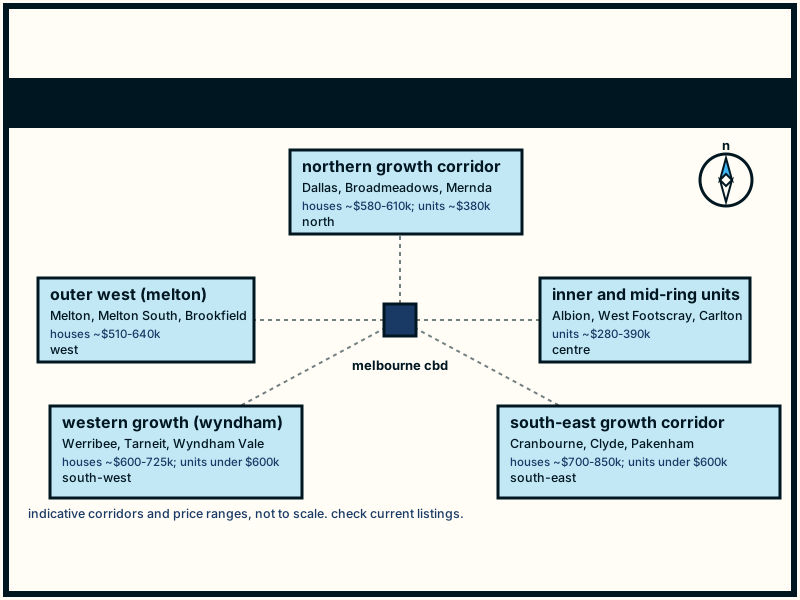
| corridor | example suburbs | indicative range |
|---|---|---|
| the outer west (melton corridor) | Melton, Melton South, Melton West, Kurunjang | houses roughly $510k to $640k |
| the western growth corridor (wyndham) | Wyndham Vale, Werribee, Tarneit, Truganina | established houses roughly $600k to $725k; new house-and-land packages and townhouses can sit under $600k |
| the northern growth corridor | Dallas, Broadmeadows, Roxburgh Park, Craigieburn | Dallas houses around $580k and Broadmeadows around $610k; Craigieburn houses have moved well above $600k (around $715k), while Mernda units sit near $380k |
| the south-east growth corridor | Cranbourne, Cranbourne West, Clyde, Officer | established houses now roughly $700k to $850k; new house-and-land packages, units and townhouses in newer estates can come in under $600k |
| inner and middle-ring units (under-$600k apartments) | Albion, West Footscray, Travancore, Caulfield East | units roughly $280k to $390k |
| corridor | areas | home types |
|---|---|---|
| west and outer-west | wyndham and melton, werribee, tarneit | newer estates, house-and-land, townhouses |
| north | hume growth area, craigieburn, mickleham | newer growth-estate stock, more house for your money |
| outer-southeast (casey-cardinia) | cranbourne, clyde, pakenham, officer | new builds and townhouses |
| established middle-ring pockets | closer-in suburbs | units, older apartments, small townhouses |
worth knowing
check what's actually selling, not what's listed. sold prices are reality, listing prices are hopes, so work off real recent sales in any corridor before you commit.grab my affordable-suburbs guide
a corridor-by-corridor way to point your melbourne search without chasing a stale price.
first home buyer schemes that apply in melbourne and victoria
this is the part that genuinely changes the maths, so it's worth getting your head around. as a first home buyer in melbourne, you've potentially got two layers of help stacked on top of each other, federal schemes that apply australia-wide, and victorian schemes run by the state. they can work together, and missing one of them is basically leaving money or savings on the table.
on the victorian side, the big ones are the first home buyer stamp duty exemption or concession (which can wipe out or reduce one of your largest upfront costs, up to a price cap), the first home owner grant (a one-off payment aimed mainly at new homes), and the off-the-plan duty concession (which can reduce duty on eligible off-the-plan purchases). all three are run by the state revenue office of victoria, and all three have rules and caps that change, so they're a "check the current rules" item every time.
on the federal side, you may be able to use the australian government's low-deposit scheme (which can let eligible first home buyers in with a smaller deposit and without paying lenders mortgage insurance), the first home super saver scheme (which lets you save for a deposit through your super), and help to buy (a shared-equity scheme). i've explained how all of these fit together, who they're for and how they interact, on the deposit and grants pillar, that's the page to read before you do anything else. the short version for melbourne, check both layers, because the federal price caps and the victorian price caps both matter, and they're not the same number.
| layer | main schemes | run by |
|---|---|---|
| victorian | stamp duty exemption or concession, first home owner grant, off-the-plan duty concession | state revenue office of victoria |
| federal | low-deposit scheme, first home super saver scheme, help to buy | australian government |
worth knowing
check both layers, because the federal price caps and the victorian price caps both matter and they are not the same number. amounts and caps change, so confirm the current rules each time.the victorian stamp duty exemption and concession for first home buyers
stamp duty (victoria calls it land transfer duty) is usually the single biggest upfront cost after your deposit, so this is the scheme that moves the needle most for melbourne first home buyers. the good news, victoria has a first home buyer duty exemption and a concession, which means eligible first home buyers may pay no duty at all up to one price threshold, and reduced duty on a sliding scale up to a higher one. that can be many thousands of dollars staying in your pocket, which is a serious chunk of a deposit.
i'm deliberately not quoting the thresholds here, because they're exactly the kind of figure that gets updated and i don't want you planning around a stale number. the move is to go to the state revenue office of victoria, look up the first home buyer duty concession, and check three things for your situation, whether you're eligible, what the current price thresholds are, and how much duty (if any) you'd actually pay at your price. that last one matters in melbourne especially, because a property just over the threshold can mean a very different bill to one just under it.
one more honest note. the duty rules treat new and established homes the same for the exemption and concession in victoria, which is different to the grant (the grant is mostly new-build only). so don't assume you have to buy new to get the stamp duty break, that's a common mix-up. check the current rules, because the detail is what decides it, and confirm your number with the state revenue office before you budget.
a common mix-up
the victorian stamp duty exemption and concession treat new and established homes the same, so you don't have to buy new to get the duty break. check the current rules and confirm your number with the state revenue office before you budget.how much deposit do you need to buy in melbourne?
the deposit question is the one i get asked most, and the honest answer is, it depends, but let me give you the real ranges rather than a vague shrug. the textbook deposit is 20% of the purchase price, because at 20% you avoid lenders mortgage insurance, the one-off insurance that protects the lender (not you) when your deposit is smaller. on a melbourne first home, 20% is a big number, so most first home buyers don't actually start there.
in practice, plenty of melbourne first home buyers buy with far less than 20%, often around 5% to 10%, especially when they use the federal low-deposit scheme, which can let eligible buyers in with a smaller deposit and skip lmi. that's the scheme that quietly does the heavy lifting for a lot of first home buyers, because saving 20% in a city like melbourne can take years, and the deposit scheme can shave a big chunk of waiting off the front. there's a catch worth knowing, a smaller deposit means a bigger loan and bigger repayments, so cheaper to get in doesn't always mean easier to hold.
here's what i'd actually do. work out your real all-in number, deposit plus the upfront costs (conveyancing, inspections, any duty you do pay), because the deposit alone isn't the whole entry cost. then check whether you qualify for the low-deposit scheme or the first home super saver scheme, because both change how much cash you need up front. i've laid all of this out, with the deposit ranges and how the schemes stack, on the deposit and grants pillar. and because the borrow-versus-should-borrow gap is real, getting your specific numbers checked early is the thing that saves the most stress later.
general information only, a smaller deposit means a bigger loan and higher repayments, so get your own numbers checked.
grab my deposit roadmap
how the deposit ranges and the schemes stack up so you know the real cash you need up front.
victoria first home owner grant and off-the-plan concession
two more victorian levers worth understanding, the first home owner grant and the off-the-plan duty concession. both are run by the state revenue office of victoria, and both lean toward new or off-the-plan homes, which matters a lot in melbourne because so much of the affordable, under-$600k stock in the growth corridors is exactly that, brand-new townhouses and house-and-land.
the first home owner grant is a one-off payment that may be available to eligible first home buyers, and in victoria it's aimed mainly at new homes, buying or building a brand-new place rather than an established one. that makes it a natural fit for the outer growth corridors, where new builds are the norm. the amount, the price cap and the exact "what counts as new" rules are set by the state and change, so it's a check-the-current-rules item every single time. don't assume the grant applies to an established unit in a middle suburb, because usually it won't.
the off-the-plan duty concession is the other one to know if you're considering buying off the plan (signing before, or during, construction). it can reduce the duty payable on eligible off-the-plan purchases, because duty may be calculated on a lower value at the time you sign. that's why off-the-plan can sometimes work out cheaper on duty than buying the same finished home, but the rules, eligibility and caps change, so check the current detail with the state revenue office before you rely on it. as with everything here, confirm your own figures, the concession is only worth what it's actually worth for your purchase.
how to shortlist a melbourne suburb without overpaying
finding an affordable suburb is the easy half. not overpaying for a home in it is the half that actually protects your money, so here's how i'd shortlist, the practical version.
start with your honest budget and your honest commute. pick the maximum price you can comfortably hold (not the maximum a lender will give you), then map which corridors fall inside it and how long the trip to work or study really is from each. a place that's $40k cheaper but adds an hour each way isn't always the saving it looks like. next, look at the boring fundamentals, transport links, whether there's a train line, what's planned for the area, and how much new supply is coming. in growth corridors especially, a lot of new stock arriving at once can hold prices flat, which is great when you're buying and worth knowing about.
then do the bit most first home buyers skip, research what places have actually sold for, not what they're listed at. listing prices are hopes; sold prices are reality, and knowing the street's real recent sales is how you walk into a negotiation or an auction on level ground instead of guessing. finally, get your own numbers checked before you commit, your borrowing power, your real deposit position, and which victorian and federal schemes apply to the specific home you're eyeing. if you want a hand with that part, the team at finance lab can walk through your situation. that's general information, not personal advice, but it's the step that turns "i think i can afford this suburb" into "i know i can."
victorian first home buyer stamp duty exemption and concession
victoria offers eligible first home buyers an exemption from land transfer duty (stamp duty) up to one price threshold, and a concession on a sliding scale up to a higher threshold. it applies to both new and established homes for first home buyers. price thresholds, eligibility rules and the concession scale change, so check the current amount and rules before you budget. last reviewed June 2026. official source: state revenue office of victoria, first home owner, https://www.sro.vic.gov.au/first-home-owner.
last reviewed june 2026
victorian first home owner grant (fhog)
the victorian first home owner grant is a one-off payment that may be available to eligible first home buyers, aimed mainly at new homes (buying or building a brand-new property rather than an established one). the grant amount, price cap and the rules for what counts as a new home are set by the state and change. check the current amount and rules with the state revenue office before you rely on it. last reviewed June 2026. official source: state revenue office of victoria, first home owner, https://www.sro.vic.gov.au/first-home-owner.
last reviewed june 2026
victorian off-the-plan duty concession
victoria has an off-the-plan duty concession that may reduce the land transfer duty payable on eligible off-the-plan purchases, because duty can be assessed on a lower value at the time of signing. eligibility, the way it is calculated and any caps change, so check the current rules before you sign. last reviewed June 2026. official source: state revenue office of victoria, https://www.sro.vic.gov.au/.
last reviewed june 2026
federal schemes that also apply in melbourne
on top of the victorian schemes, eligible melbourne first home buyers may also be able to use federal help: the australian government's low-deposit scheme (which can let eligible buyers in with a smaller deposit and without lenders mortgage insurance, see housing australia, https://www.housingaustralia.gov.au/support-buy-home), the first home super saver scheme (saving a deposit through super, see the ato, https://www.ato.gov.au/individuals-and-families/super-for-individuals-and-families/super/withdrawing-and-using-your-super/first-home-super-saver-scheme), and help to buy (a shared-equity scheme, see housing australia, https://www.housingaustralia.gov.au/help-buy). federal price caps differ from the victorian caps and all amounts, caps and eligibility change. check the current rules with each official source. last reviewed June 2026.
last reviewed june 2026
 hear it on the showbuying your first home in melbourne
 hear it on the showcity unit vs suburb house: which one should you buy?
 hear it on the showunderstanding how home grants work!
also by location: what it costs to buy a first home first home buyer Victoria
frequently asked questions
what are the cheapest suburbs in melbourne to buy a first home?
the most affordable parts of melbourne for first home buyers are generally the outer growth corridors, the west and outer-west (wyndham and melton areas), the north (hume growth area), and the outer-southeast (casey-cardinia around cranbourne, clyde and pakenham), where newer townhouses and house-and-land are priced for first home buyers. established middle-ring suburbs can also work if you look at units and small townhouses rather than freestanding houses. i'm not naming specific prices because they move constantly, this is general information only, so check current listings in any area before you commit.
do first home buyers pay stamp duty in victoria?
eligible first home buyers in victoria may pay no land transfer duty (stamp duty) at all up to one price threshold, and reduced duty on a sliding scale up to a higher one, and it applies to both new and established homes. that can save many thousands of dollars. the thresholds and rules change, so this is general information only, check the current rules and your eligibility with the state revenue office of victoria (sro.vic.gov.au/first-home-owner) before you budget.
what is the victorian first home owner grant worth?
the victorian first home owner grant is a one-off payment for eligible first home buyers, aimed mainly at new homes (buying or building brand-new rather than established). the grant amount, price cap and new-home rules are set by the state and change, so i won't quote a figure here. this is general information only, check the current grant amount and eligibility with the state revenue office of victoria (sro.vic.gov.au/first-home-owner).
how much deposit do i need to buy a first home in melbourne?
the textbook deposit is 20% of the price, which avoids lenders mortgage insurance, but most melbourne first home buyers buy with less, often around 5% to 10%, especially using the federal low-deposit scheme, which can let eligible buyers in with a smaller deposit and skip lmi. remember a smaller deposit means a bigger loan and higher repayments, and you also need to budget for upfront costs on top. this is general information only, get your own numbers checked, and see the deposit and grants pillar for the full breakdown.
is buying off the plan cheaper for first home buyers in melbourne?
buying off the plan can sometimes reduce your stamp duty, because victoria has an off-the-plan duty concession where duty may be assessed on a lower value at the time you sign, and a lot of melbourne's affordable new stock is off-the-plan or new build, which can also suit the first home owner grant. it isn't automatically cheaper overall though, and the rules and caps change, so this is general information only, check the current off-the-plan concession rules with the state revenue office of victoria before you rely on it.
what is a realistic first home budget in melbourne in 2026?
a lot of melbourne first home buyers search under about $600k, because that's where outer-corridor townhouses, house-and-land and middle-suburb units tend to line up with first home buyer deposits and the scheme price caps. but "under $600k" is a search filter, not your real budget, your true number is your borrowing power plus deposit, minus upfront costs. this is general information only, so set your real budget with your own figures first, then let it choose the corridor, not the other way around.
general information only, not personal financial advice. Finance Lab, Credit Representative Number 425945, authorised under Australian Credit Licence Number 389328. scheme, grant and cost figures are explanatory only, change regularly, and were last reviewed june 2026. always confirm current rules with the relevant government source.